Table of Contents
▼
Cloud and SaaS architecture define multi-tenancy as a single copy of an application that supports multiple customer organizations (or tenants) while separating each organization’s data and configuration. This is in contrast to a single-tenant operation where each customer is provided their own copy of the application. For SaaS product companies, the decision between these approaches will affect the cost model, security and compliance, flexibility and customization, infrastructure and development, and maintenance of the product.
Xcentric Services is capable of collaborating with companies from product planning to design, architecture, and software creation, by turning its requirements of tenancy in actual functioning software-as-a-service platform. Every service is categorized as strategy, architecture and development, covering experience in web applications, SaaS and corporate portals.
How Multi-Tenant Architecture Works
It becomes easier to make up one’s mind on multi-tenancy, single-tenancy or hybrid approaches if one starts from the actual requirements of the product. If you have developed a new SaaS software, upgraded the old one or have to determine if the user's data should be isolated, Xcentric Services will assist you with the planning, design and process of the implementation.
Providing SaaS, UI/UX designing and custom software development, Xcentric offers a complete package of services in the sphere of digital products.
Xcentric has built its range of services upon SaaS design, development, UI/UX, MVP development and custom software development.
Multi-Tenant SaaS Architecture
In a multi-tenant architecture, a system is designed to allow multiple customers to use the same application, while differentiating between the data, configurations, and permissions of each customer. An analogy is a building with multiple separate units, but shared building resources.
In the context of multi-tenant SaaS, a user logs into the application, the application determines the user's organization, and following that determination, all request processing is done in the context of that tenant. The application needs to provide that context and enforce this across all systems including databases, APIs, files, and background jobs.
One way to think of a multi-tenant system is through the following three layers:
Layer | Primary Functionality | Examples |
Application/data | Executes workload for the customer | Business logic, data, files, reports |
Control plane | Manages the tenant and application | Provisioning, configuration, onboarding, billing |
Identity | Determines access by tenant | Authentication, authorization, permissions |
There is no architectural mandate to this division; however, it is a useful way to understand how the boundaries of a system can be delineated.
This architecture minimizes duplication of infrastructure and simplifies management of centralized applications. This, however, depends on how resource consumption, operational constraints, and tenant boundaries are defined.
Architectural planning must happen before development becomes coupled to any particular tenancy model. Xcentric Services transforms SaaS demands into tailored applications, custom SaaS offerings, and enterprise solutions that unify architecture and development. So rather than viewing infrastructure as an afterthought, we suggest incorporating development efforts as well.
Isolation Patterns: Silo, Pool, and Hybrid
Silo, pool, and hybrid can all be useful descriptions for tenant isolation approaches. Rather than three established patterns, they should be viewed as a spectrum or a common framework for architecture.
For the silo model, tenants are provisioned with dedicated infrastructure (or dedicated databases). This creates a much stronger boundary, but will generally consume more resources and will require more operational management.
The pool model puts multiple tenants on the same infrastructure. Logical constraints will secure their data and control their access. This may be efficient from a resource perspective. However, the application must enforce those boundaries correctly.
The hybrid model combines aspects of both the pool and silo model. For example, in a typical scenario, the majority of customers/tenants are allocated on shared infrastructure. Customers/tenants with compliance, security, workload, etc. requirements that differ from the majority are allocated on dedicated infrastructure.
Pattern | Isolation approach | Operational overhead | Suitable when |
Silo | Dedicated resources per tenant | High | Strong isolation is needed |
Pool | Common infrastructure (shares infrastructure | High | Tenant requirements are similar |
Hybrid | Shared and dedicated resources combined | Medium to high | Mix of high and low affects price |
It's not about whether silo or pool is better. Examine the clientele and the applications and see what level of isolation is needed. A startup with similar clients may care more about cost-effective shared infrastructure. An enterprise SaaS platform may have clients with dedicated resource needs from contracts or regulations. The hybrid option can also help avoid forcing every client into the same infrastructure model.
Data Isolation Strategies
There are different ways to build a multi-tenant database. Some examples are database-per-tenant, schema-per-tenant, and shared database/shared schema. Each has a different balance of isolation, operations, and infrastructure.
Strategy | Structure | Isolation type | Thing to consider most |
Database per tenant | Each tenant has their own database | Stronger separation at the database level | More databases (and therefore more resources) to manage |
Schema per tenant | Tenants have different database schemas | Logical separation in a database | Schema management |
Shared database/Shared schema | Tenants share tables, identified by a tenant context | Relies on access control | Needs tenant-aware data controls |
Multi-tenant database design is more than creating a tenant_id field. Your system must consider queries, background processes, exports, APIs, caching, search, file storage, and administrative processes.
If you are using platforms built on PostgreSQL, row-level security is relevant in the context of enforcement of tenant access to the database. The rest of the architecture requires application-level authorization and testing.
A related question is databases for each tenant or a shared database. There is no best option. A database for each tenant provides more separation, whereas a shared database can provide a more simplified and efficient use of resources. The most appropriate choice depends on the number of tenants, compliance, operational capability, and workload.
Multi-Tenant vs. Single-Tenant Architecture
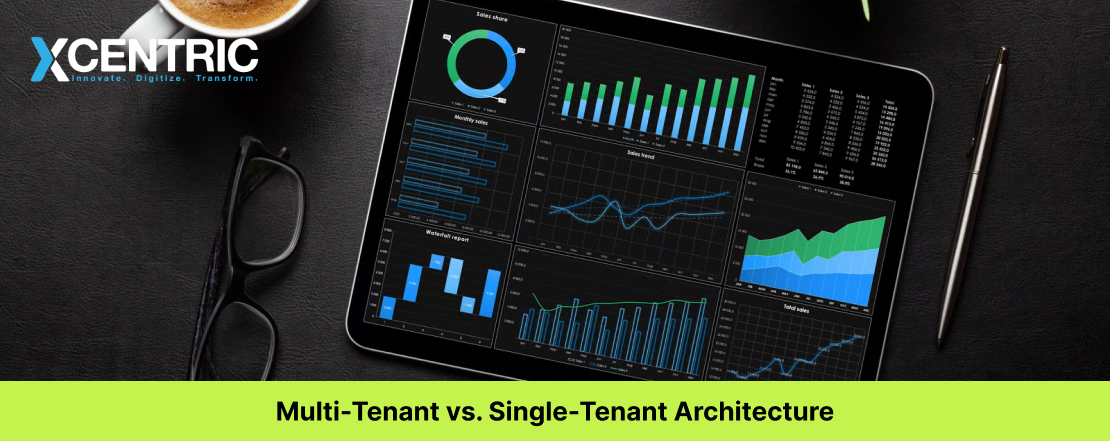
The main difference between multi-tenant architecture and single-tenant architecture is how much of the infrastructure is shared between different customers. In multi-tenancy, customers are logically segregated but reside in a shared application environment, whereas in single-tenancy, customers are allocated a dedicated application environment.
Beyond infrastructure, the choice has implications on how a SaaS product is developed, deployed, customized, and secured. It can also impact the economics of resource management.
Factor | Multi-Tenant | Single-Tenant | Better fit |
Cost efficiency | Multi-tenant is cost-efficient at scale | Costly at scale | Cost becomes relevant at scale |
Isolation | Logical isolation is possible with default configurations | A dedicated environment is the only isolation boundary | Silo/ hybrid DevOps approach might be compliant |
Operational overhead | Siloed deployments can introduce duplication | Each environment requires separate administration | Efficiency of deployment is prioritized |
Customization | Changes require coordination with other tenants | Changes are easier in a dedicated environment | Customization might be prioritized over deployment efficiency |
Upgrades | Centralized control over releases might decrease time to update | Customer environments may require separate deployment | Efficiency of deployment is prioritized |
Cost and operational efficiency
Multi-Tenancy allows shared application infrastructure across multiple tenants and might eliminate duplicated environments. Centralized deployment, however, might become more complex. Large single-tenant environments may increase operational costs. Multi-Tenancy may require more infrastructure to support tenants but dedicated resources may be justified.
Isolation and compliance
Requirements that mandate compliance and separation of control overlap with single-tenancy environments. Dedicated resources are part of the control framework for silo-based arrangements. Multi-Tenancy may also provide strong isolation but correct implementation is critical.
Rewarding Loyal Customers With Tailored Solutions
It's natural for business applications to have functions that can be adjusted to serve different customer needs. The use of customer-specific code across multiple instances can compromise the software's performance if each customer requires a specific variation of the software.
Strictly dedicated instances of software are the solution to this problem since changes can be applied to a single instance.
Optimal Resource Utilization
Whether to use multi-tenant or single-tenant instances also depends on how the software is meant to be used. Shared infrastructures can help provide the optimal distribution of resources among several customers, but without proper controls, one customer's heavy use can negatively affect other customers.
The use of separate instances of software ensures resource consumption is isolated, but each instance must be scaled independently. For a Software as a Service (SaaS) business, the best architecture is often the one that best meets the capacity and operational requirements of the anticipated demand.
If you're considering developing a new SaaS offering, Xcentric Services is able to perform an assessment of your anticipated tenant mix, integration requirements, and the operational model to be employed, which informs the optimal development approach. Xcentric offers a range of services from UI/UX design, web development, and custom software to SaaS solutions and enterprise portal development.
Security and Tenant Isolation
Tenant Isolation doesn't just mean defining the customer's businesses. A secure multi-tenancy design encompasses separate layers for authentication, authorization, and data access, all of which are supported by encryption, auditing and operational controls.
Answering authentication means asking “who” the user is.
Answering authorization means asking “what” is the user allowed to do?
The enforcement of data access answers “Can this request access this specific tenant's resource?” This is where the application or database stops one tenant from retrieving another tenant's data.
The layers get blurry. A correctly authenticated user may still be unauthorized to access a certain resource, and an authorized user may still experience a cross-tenant data leakage problem if tenant context is incorrectly applied.
What it Protects Against | Security Area |
Authentication | Unauthorized identity access |
Authorization | Users exceeding their permissions |
Tenant-aware data controls | Cross-tenant data exposure |
Encryption | Unauthorized access to protected data |
Logging and auditing | Difficult-to-detect access or configuration events |
Resource controls | Noisy-neighbor performance problems |
The noisy-neighbor problem is when one tenant uses a significantly disproportionate amount of combined system resources (e.g. CPU, memory, bandwidth, etc.) and impacts the other tenants of a shared environment.This can be reduced through policies such as rate limiting, resource quotas, and workload isolation.
For multi tenant cloud security, organizations should analyze both data and infrastructure boundaries. A platform may correctly ensure Tenant A cannot read Tenant B’s records; it may be permissible for Tenant A’s workload to consume disproportionate shared resources.
For SaaS applications in particular, these considerations are of the most importance and must be addressed at the earliest opportunity, preferably during the design and development phase. Xcentric Services provides companies with the ability to plan and develop digital products according to their requirements.
Multi-tenant Architecture for AI Agents: What Makes it Unique
Multi-tenancy of AI agents may introduce additional challenges to accommodate agent retrieval of tenant-specific data and/or the persistent storage of state, invocation of external agents, and execution of code. This challenge should not be generalized to the extent that every AI-enabled SaaS application needs an agent-isolation architecture. The challenges would depend on what the AI agent would have access to and would be able to accomplish.
Traditional multi-tenant SaaS architecture focuses primarily on preventing Tenant A from reading Tenant B’s application data. With agents, additional boundaries could become pertinent around computation, credentials, model context, tool permissions, and state.
Take, for instance, an AI agent leveraging RAG (Retrieval-based Augmented Generation). In such a case, simply separating tenants at the relational database level may not suffice. At the retrieval layer, the other tenant’s embeddings or documents should not be presented in the other tenant’s search context. Vector-namespace isolation is one way to structure this.
There are also cases of credentials. If an agent can access a CRM, payment system, or internal API, it would mean the agent has the permissions to perform those tasks. Per-tenant credential scopes and secure credential storage would be the case.
Agents are also dealing with capability-based access controls. In the context of RBAC (Role-Based Access Control) capabilities, the focus is on the control and the tools that an agent is permitted to invoke.
Agent concern | Multi-tenant consideration |
Tenant data retrieval | Separate retrieval context or vector namespaces |
Credentials | Scope credentials to the relevant tenant |
Tool access | Restrict which capabilities an agent can invoke |
Rate limits | Prevent one tenant's agent usage from overwhelming shared resources |
Persistent state | Keep tenant-specific state properly separated |
For SaaS companies, the main consideration around AI integration is not whether to use AI, but where the AI is allowed to operate in tenant environments.
Choosing the Right Tenancy Model
There is no ideal multi-tenant architecture for everyone. The best model is decided based upon the customers, compliance regulations, workload, and operational factors.
When discussing compliance, consider any customers who may be contractually, legally, or otherwise internally binding your company to dedicated infrastructure. If that is the case, a single-tenant or silo model may work best for those customers.
If your customers vary greatly in the number of customers and the type of usage, shared infrastructure may or may not be a good option. If your customers have similar usage but a small number of customers have substantially larger workload requirements, then it may be worthwhile to adopt a hybrid model.
Shared infrastructure is only an effective way to save cost if the application is designed around data and resource isolation.
This is the part where the uncertainty goes away thanks to professional architecture and development. Xcentric Services offers businesses the ability to move their product requirements to architecture and design as well as implementation, including SaaS, custom web apps and enterprise solutions. Build depending on your requirements, not around a given tenancy model.
Build Your Multi-Tenant SaaS Product With Xcentric Services
Picking a tenancy model is just the starting point. A production SaaS application must transform this choice into database structures, authentication, authorization, application logic, infrastructure, interfaces and operational processes.
Xcentric Services has a unique advantage because of its commitment to strategy, design and development. SaaS design and development, as well as UI/UX design and MVP development, custom web apps, and enterprise portals are the services the company offers.
In SaaS development and architecture, this commitment enables Xcentric Services to provide SaaS design and development services and treat SaaS development from the perspective of a complete digital product rather than making architecture an isolated decision of a database.
Requirements for a new SaaS product | Services offered |
New SaaS product | Product strategy, design and development |
Multi-tenant architecture | Architecture planning and custom development |
Existing SaaS platform | Development and architecture improvements |
Tenant-aware application | Application and database implementation |
Product interface | UI/UX design |
SaaS MVP | MVP design and development |
Ongoing product needs | Continued development and improvements |
Regardless if you are developing a customer-facing SaaS platform from scratch, modernizing existing applications, or validating an MVP, your architecture must reflect your product's requirements.
Conclusion
For SaaS offerings, multi-tenancy can be an effective design choice, but the architecture should be aligned with the offerings. Several factors, including access management, resource management, and artificial intelligence (AI) can significantly impact the architecture design.
If you are deciding on single-tenant, multi-tenant or hybrid architecture, consider engaging Xcentric Services. We will evaluate the product requirements and determine the most appropriate architecture.
Xcentric offers a multitude of services and technical solutions to support you in the development of your innovative ideas, from conception to product delivery.
Frequently Asked Questions
Q. What is multi-tenancy?
Multi-tenancy refers to an application that can be used by multiple customer organizations through logical separation of data, configuration, and access. SaaS is built on multi-tenancy architectures since a single instance of an underlying application and infrastructure can be used by multiple customers, who are isolated from each other.
What are the differences between single-tenancy and multi-tenancy?
A single-tenancy architecture provides a dedicated application environment for each customer. In multi-tenancy, a single application environment is shared by multiple customers, but each customer is separated from the rest in terms of access and data. The choice of either architecture depends on the workload, customization/compliance, isolation, and operational capacity.
What is a tenant in cloud computing?
In cloud computing, a tenant refers to a customer or an organization that uses shared cloud resources and is logically separated from other tenants. In a SaaS application, a tenant is a customer organization and its users, data, configuration, and access resources.
Which one is more secure, multi-tenancy or single-tenancy?
Neither architecture is more secure in all cases. Single-tenancy provides dedicated environments, and multi-tenancy relies on the implementation of logical isolation and access control. The best architecture for a given case depends on compliance requirements, threat modeling, and the quality and extent of implementation of the architecture.
What is silo vs pool multi-tenancy?
In silo multi-tenancy, tenants are allocated their own dedicated resources or databases, thereby providing stronger level of separation at the infrastructure or data layers. In pool multi-tenancy, tenants are not allocated resources of their own, and separation is enforced by means of logical controls. Hybrid designs can be used to accommodate different levels of isolation by combining the different aspects of silo and pool multi-tenancy.
Is multi-tenant architecture cheaper than single-tenant?
From a cost perspective, shared resource modules tend to reduce infrastructure and operational costs. Although this is the case, multi-tenant setups do not necessarily tend to be cheaper. Costs are typically a function of the number of tenants, resource consumption, levels of isolation, required tools, and customization. From a cost perspective, single-tenancy can be justified if dedicated infrastructure or significant customization is required.
Share



Want To Increase Your Ranking On The Search Engines?
Get In Touch With Us!
Trending Blogs
Digital Marketing...
Xcentric Team
8 MONTHS AGO

What To Read Next?

For owners and managers of dental clinics in Lahore, here is a critical fact you...
Xcentric Team
8 MONTHS AGO

The Middle East e-commerce industry is rapidly growing due to increased digital acceptance, mobile-first consumers...
Xcentric Team
9 MONTHS AGO

These days, the e-commerce industry is growing at an exponential rate. With the rise of...
Xcentric Team
9 MONTHS AGO